
At a glance
What international buyers should know
- A car is not essential for every French Riviera owner. Central Nice, Cannes, Antibes, Villefranche-sur-Mer, Beaulieu-sur-Mer and Menton can support a car-light routine when the home is genuinely walkable from transport and daily services.
- The coastal train is the regional spine, but a station name does not prove easy access. Hills, stairs, heat, luggage and the final route to the property can change a short map distance into a car-dependent address.
- Saint-Jean-Cap-Ferrat, Èze village, Cap d'Antibes and residential hillsides require a more careful test because rail stations may sit outside the daily center or far below the property.
- Many international owners will find a hybrid model more practical: walking and rail for ordinary life, with prearranged transfers, taxis or a locally managed vehicle for specific journeys.
The direct answer: yes, if you buy the right address
You can live on the French Riviera without owning or using a car every day. For an American buyer, the strongest car-light locations are usually central neighborhoods and coastal towns where the home, train station, groceries, restaurants, medical services and waterfront can be reached on foot. Nice offers the broadest public transportation network and a direct airport connection. Cannes, Antibes and Menton also provide walkable central districts around their railway stations. East of Nice, Villefranche-sur-Mer and Beaulieu-sur-Mer can work well when the exact home sits near the center rather than high above it.
The answer changes quickly on the hillsides and capes. A villa above Villefranche, a home near Èze village, a private position on Saint-Jean-Cap-Ferrat or Cap d'Antibes, and many properties overlooking Monaco may require a car, driver or frequent taxi use even when a station appears close on a map. The decision is therefore not simply whether a town has public transportation. It is whether the specific front door supports the routine you expect to live.
For most international second-home owners, the best answer is not strictly car-free or fully car-dependent. It is a deliberate hybrid: use trains, trams and walking for the journeys they handle well, then arrange a transfer, taxi, rental car or locally managed vehicle for the trips they do not.
Which French Riviera towns work best without a car?
Nice is the clearest starting point for a car-light French Riviera home. The city combines the main Nice-Ville railway station, the Nice-Riquier station near the port, three tram lines and a large metropolitan bus network. Nice Côte d'Azur Airport is west of the center, and the airport's official public transportation page confirms tram service from both terminals. For owners arriving from the United States with luggage, that direct connection can remove one recurring piece of transportation planning.
Cannes and Antibes also place their main stations close to established centers, shops, restaurants and waterfront routes. A central apartment can support ordinary stays on foot, while regional trains connect both cities with Nice and other coastal destinations. Local networks then extend the usable area: Palm Bus serves Cannes and the surrounding Pays de Lérins communities, while Envibus serves Antibes, Juan-les-Pins and neighboring Sophia Antipolis communities.
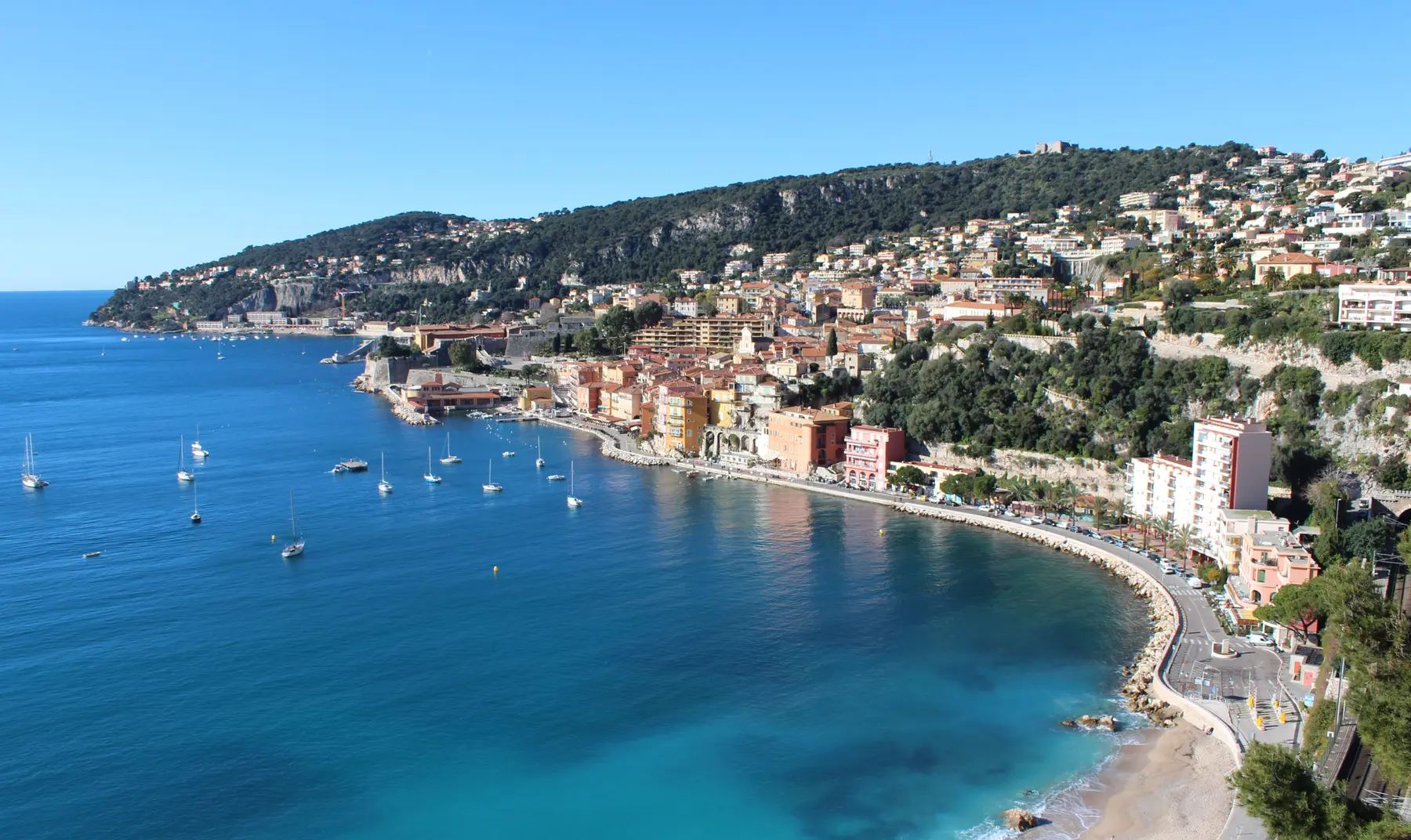
Menton, near the Italian border east of Monaco, offers a compact center with rail access and a year-round town structure. Villefranche-sur-Mer and Beaulieu-sur-Mer, between Nice and Monaco, can also support a low-car routine, but topography makes the address test more important. A central Beaulieu apartment and a hillside home above the bay may share the same postal town while producing entirely different daily lives.
How useful is the coastal train for an owner?
The TER regional train is the main public transportation spine along this part of the Côte d'Azur. SNCF's current regional information, reviewed on September 3, 2026, confirms TER service across Provence-Alpes-Côte d'Azur through Cannes, Antibes, Nice and Monaco. Current Nice-to-Ventimiglia schedules show the eastbound sequence through Nice-Riquier, Villefranche-sur-Mer, Beaulieu-sur-Mer, Èze, Cap-d'Ail, Monaco-Monte-Carlo and Menton before reaching Italy.
That line makes many coastal journeys straightforward, but it should not be treated like an urban subway. Service intervals vary by time and day, stations can be busy, and disruptions or late-evening plans require alternatives. Owners should check live schedules for each stay and understand the last practical connection rather than relying on a routine remembered from summer.
The station name can also be misleading. Èze station is at Èze-sur-Mer on the coast, below the medieval hilltop village commonly called Èze. Cap-d'Ail station is by the shoreline, while residential properties can rise steeply above it. In Villefranche-sur-Mer, the climb from the station toward higher residential streets can be material. The train may connect the towns; it does not solve the final elevation.
What changes east of Nice toward Monaco?
The compact coast between Nice and Monaco looks exceptionally connected on a regional map. In practice, bays, cliffs and steep roads divide short distances into distinct daily routines. Before buying in Villefranche-sur-Mer, Beaulieu-sur-Mer, Èze, Cap d'Ail or Roquebrune-Cap-Martin, walk from the relevant station to the property with the conditions of a real arrival in mind: luggage, groceries, summer heat, rain, evening light and the mobility of every regular guest.
Saint-Jean-Cap-Ferrat, on the French Riviera between Nice and Monaco, has no railway station on the cape itself. Beaulieu-sur-Mer is the nearest rail point for many journeys, followed by a walk, local bus, taxi or arranged pickup. A village apartment can support a much lighter transportation pattern than a secluded villa farther south. The same distinction applies around Cap d'Antibes, where the center of Antibes and its station do not automatically make the full cape practical without a vehicle.
A buyer should also separate access for the owner from access for the household. Children, older relatives, staff, contractors and guests may not use steep walks or public transportation in the same way. A home is not truly car-light if every ordinary visit still requires someone else to drive.
When does a car become useful or necessary?
A car becomes materially more useful when the property is on a hillside, behind a long private approach or outside a walkable center. It also matters when the household regularly travels to international schools, sports facilities, marinas, golf courses, beach clubs, inland villages or large supermarkets. These destinations may be served by buses, but the full door-to-door routine can involve connections, limited hours or a walk that is unrealistic for daily family life.
Property type changes the answer as well. A lock-up-and-leave apartment beside a station asks little of the transportation plan. A villa with grounds may require regular visits from gardeners, pool technicians, housekeepers, security providers and maintenance teams. Their access is part of the operating system, even if the owner personally prefers trains and walking.
Do not evaluate the question only during a relaxed holiday. Test an airport arrival after a long flight, a grocery run, an evening return, a medical appointment and a day when the coastal rail line is disrupted. The property should still function when the attractive journey is unavailable.
Should you keep a car at a second home?
Keeping a vehicle locally can provide flexibility, but it creates its own ownership work: secure parking, insurance, registration, battery care, servicing and someone able to move or inspect it during long absences. A garage must be measured for the actual vehicle, including turning radius and the approach from the street. Older Riviera buildings and tight village lanes do not always match the dimensions American drivers expect.
Some owners will be better served by airport transfers and taxis, supplemented by short-term rentals for inland trips. Others will value a locally stored car enough to accept the administration. The useful comparison is the annual pattern of real journeys, not the symbolic convenience of having a vehicle available.
How should you test a property for car-light living?
Run a transportation audit before treating walkability as part of the property's value. Begin at the airport or station you will actually use. Complete the final approach with luggage. Walk to groceries, a pharmacy and dinner. Check the return after dark. Look at elevation rather than straight-line distance, and identify the taxi pickup point, delivery route and backup option when service changes.
- Time the door-to-platform journey rather than measuring distance on a map.
- Test stairs, gradients, crossings and shade with the least mobile regular guest in mind.
- Check current train, tram and bus information for weekdays, Sundays and the season you expect to use the home.
- Locate practical daily services, not only restaurants and the waterfront.
- Price parking, transfers, taxis or vehicle management as part of annual ownership.
- Confirm how caretakers, tradespeople and emergency services reach the property during your absence.
What is the best transportation model for an international owner?
The most resilient model is usually layered. Choose an address that makes ordinary life possible on foot. Use the coastal train and local networks for predictable journeys. Keep trusted transfer and taxi contacts for airport arrivals, evenings and disruptions. Add a rental or locally managed car only when the household's actual pattern justifies it.
SDM Luxury Real Estate helps international buyers compare French Riviera properties through daily use as well as architecture and outlook. A focused search can test station access, walking routes, parking, service coverage and between-visit property management before a location is accepted as genuinely practical. The purpose is not to eliminate the car at any cost. It is to choose a home whose transportation demands remain proportionate to the life the buyer wants in the South of France.
General location and transportation information only. Routes, schedules, fares, accessibility, parking, traffic conditions and service areas can change. Verify the exact property, current transportation options and household requirements before acting, and obtain appropriate French legal, insurance, vehicle and property advice where relevant.
Primary sources
Official information and further reading
Facts and links reviewed September 3, 2026.
- SNCF Connect: TER Sud Provence-Alpes-Côte d'Azur (opens in a new tab)
- SNCF Connect: current Nice-Ventimiglia coastal train schedules (opens in a new tab)
- Nice Côte d'Azur Airport: official public transportation access (opens in a new tab)
- Lignes d'Azur: official Nice metropolitan network maps (opens in a new tab)
- Palm Déplacements: official Cannes Pays de Lérins network (opens in a new tab)
- Envibus: official Antibes and Sophia Antipolis transport network (opens in a new tab)
Published by SDM Luxury Real Estate (opens in a new tab) / Nice, France
Last reviewed .