
At a glance
What international buyers should know
- James Baldwin made Saint-Paul-de-Vence his principal home around 1970–71 and remained connected to the village until his death in 1987.
- The Provençal house known as Chez Baldwin was both a disciplined workplace and a gathering place for family, friends, artists and political conversation.
- Baldwin’s story reveals a quieter Riviera geography: an inland village near Nice where domestic life, hospitality and serious creative work could coexist.
Why did James Baldwin live in Saint-Paul-de-Vence?
James Baldwin made Saint-Paul-de-Vence his lasting home because the village offered something he had not found in years of movement between the United States, Paris, Turkey and other temporary addresses: a place where he could recover, write and receive people on his own terms. Accounts differ slightly on the date. The Saint-Paul-de-Vence tourism office places his arrival in 1970, while the Smithsonian’s Chez Baldwin exhibition dates the home from 1971. The clearest description is that he settled there around 1970–71 and remained until his death in 1987.
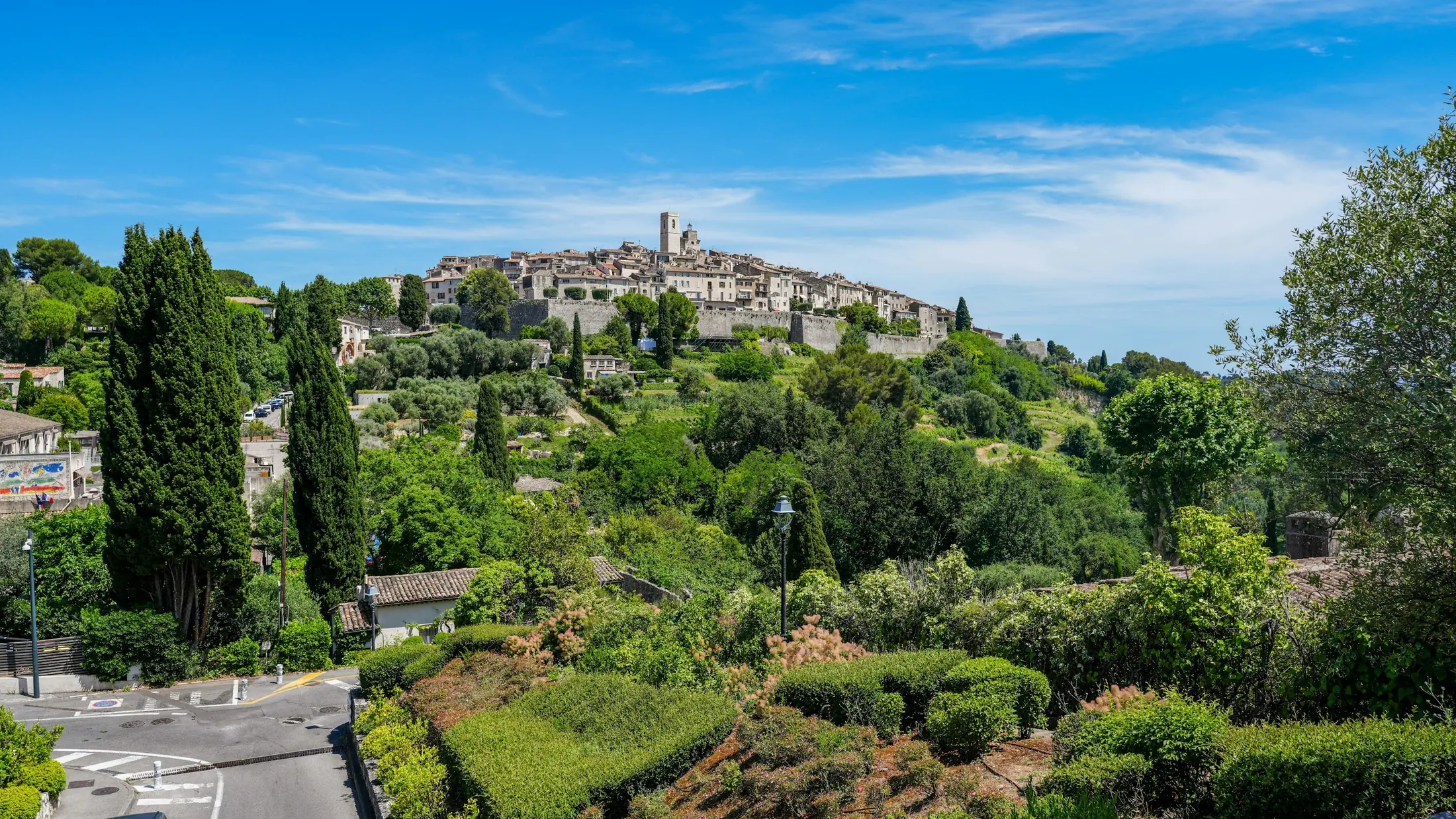
Saint-Paul-de-Vence is a fortified hill village in the Alpes-Maritimes, inland from Cagnes-sur-Mer and west of Nice. Its ramparts, stone houses and gardens place it within the cultural geography of the French Riviera without the immediate tempo of the coast. Baldwin’s house stood on Chemin du Pilon, just beyond the walls. It was close enough for him to become part of village life, yet large and private enough to support work, family and an open door.
What was Chez Baldwin?
Chez Baldwin was the name commonly given to the rambling Provençal house that became Baldwin’s final home. The Smithsonian describes a substantial stone property looking toward the Mediterranean, while local records emphasize its garden of olive and orange trees and laurels. The precise ownership history is more complicated than the familiar idea of a writer simply buying a villa. Smithsonian research notes that Baldwin occupied and acquired the property in stages and that surviving accounts differ. The house is therefore best understood through the life conducted there rather than through a simplified real-estate biography.
Baldwin wrote about the house for Architectural Digest shortly before his death; the article appeared in the August 1987 issue. By then, the rooms held books, art, papers and objects gathered across decades of travel. Photographs preserved by the Smithsonian and New York Public Library show a home used intensely rather than presented as a pristine retreat. Desks, tables, walls and garden spaces carried the evidence of work and company.
That distinction matters. Chez Baldwin was beautiful, but its significance did not come from isolation or display. It gave a writer who had lived much of his adult life abroad a dependable address. It allowed domestic order and intellectual movement to exist together: private rooms for writing, shared rooms for debate, and a garden where visitors could remain without turning the household into a formal salon.
What did Baldwin write in the South of France?
The Saint-Paul years were productive. The Smithsonian traces works of the period that include the essay collection No Name in the Street (1972), the novel If Beale Street Could Talk (1974), the film criticism of The Devil Finds Work (1976), the novel Just Above My Head (1979), The Evidence of Things Not Seen (1985) and the collected nonfiction in The Price of the Ticket (1985). Not every page can be assigned neatly to one desk or one season, but the house became the base from which this later body of work was written, revised and organized.
Local archival material also connects Saint-Paul-de-Vence with Baldwin’s open letter to Angela Davis, written in November 1970. The house did not remove him from American political life. It gave him another position from which to engage it. Mail arrived from around the world; visitors brought news and argument; travel continued. Distance and involvement were not opposites in Baldwin’s working practice.
The setting also altered the scale of daily work. A writer could move from correspondence and typescript to a long table, a garden or conversation without leaving the household. Baldwin’s later writing remained morally urgent, but the house supplied a durable frame around that urgency. Saint-Paul-de-Vence was neither an escape from history nor a decorative backdrop. It was part of the infrastructure that made the work possible.
Why is Baldwin’s welcome table central to the story?
The Smithsonian presents the welcome table as one of the defining ideas of Chez Baldwin. Family, friends, artists, activists and younger visitors gathered to eat and talk. Hospitality was not separate from the intellectual life of the house; it was one of its forms. A meal could hold argument, reassurance, performance and the exchange of news across generations and countries.
The guest list is well documented without needing to become celebrity folklore. Smithsonian archival records preserve a 1973 interview involving Baldwin and Josephine Baker at the house. New York Public Library photographs record visits and relationships that included Maya Angelou and Harry Belafonte. The Saint-Paul-de-Vence tourism office also places painter Beauford Delaney, Baldwin’s close friend and artistic elder, regularly in the garden and household.
What made the table important was not the fame of everyone seated around it. It was the structure of welcome. Baldwin’s home could gather people who arrived with different histories and public roles, while still remaining a family house and workplace. The image is useful precisely because it resists the usual myth of Riviera creativity as solitary leisure. Here, conversation and care were part of the labor.
How did Baldwin belong to the village?
Baldwin’s relationship with Saint-Paul-de-Vence extended beyond a private compound. The Smithsonian describes his integration into village life, and the local tourism office remembers him as an adopted son of Saint-Paul. He spoke French, maintained local friendships and became a familiar presence rather than a visitor passing through for a season.
France also formally recognized his work. The local historical account records his appointment as a Knight of the Legion of Honor and an honorary doctorate from the University of Nice in 1982. Those honors sit beside a more intimate form of recognition: the continuing place of Baldwin in the village’s own cultural memory, public history and archival programming.
This does not make the story uncomplicated. Baldwin’s freedom to live abroad was shaped by the racism and homophobia he confronted in the United States, and his life in France did not end his engagement with either. His belonging in Saint-Paul was real, but it was not a withdrawal from the questions that defined his writing. The house allowed him to hold local attachment and international responsibility at the same time.
What remains of Baldwin’s Saint-Paul-de-Vence today?
The strongest surviving record is dispersed rather than contained in a single preserved house museum. The Smithsonian’s Chez Baldwin project brings together photographs, objects and scholarship around the home. Its National Museum of African American History and Culture holds Baldwin family material, while the New York Public Library preserves photographic and manuscript evidence of his working and social life. Architectural Digest retains the publication record of his own 1987 account.
In Saint-Paul-de-Vence, the village, ramparts and Chemin du Pilon still establish the physical scale of the story. Visitors should not treat a private residential area as an attraction or assume that the historic interiors remain available to enter. The more responsible way to follow Baldwin here is through the public village, the official historical account and the archival collections that preserve what the house meant.
That approach also protects the distinction between a documented place and an imagined literary pilgrimage. Chez Baldwin matters because of the work, relationships and forms of care it supported. Its legacy is larger than an architectural shell, even as the physical setting helps explain why Baldwin could build a lasting rhythm there.
What does Baldwin’s Riviera reveal about making a life here?
Baldwin’s Saint-Paul-de-Vence offers a different way to understand the French Riviera. The story is not centered on a resort season. It is about continuity: a home that can hold serious work, family, returning friends and a relationship with the place beyond its public image. The coast remained close, but the inland village provided another cadence—connected to Nice and the Mediterranean while grounded in gardens, stone and everyday local recognition.
For a contemporary resident, that geography still presents a meaningful choice. Some lives belong close to the water and the energy of Nice; others need the composure of the hills, with the airport, cultural institutions and coast kept within reach. If you can imagine a Riviera home shaped by long stays, conversation and people returning to the same table, SDM Luxury Real Estate can help translate that aspiration into a focused search for the setting and property that can support it.
General cultural information only, reviewed October 3, 2026. Public access, archives, exhibitions and the physical condition or ownership of historic sites can change; confirm current details with the relevant institution. The contemporary photograph shows Saint-Paul-de-Vence as location context and does not depict James Baldwin, Chez Baldwin or an archival scene.
Primary sources
Official information and further reading
Facts and links reviewed October 3, 2026.
- Smithsonian NMAAHC: Chez Baldwin exhibition (opens in a new tab)
- Smithsonian NMAAHC: A Fine Stone House (opens in a new tab)
- Smithsonian NMAAHC: A Place for Gathering, Healing, and Writing (opens in a new tab)
- Smithsonian NMAAHC: Baldwin in France (opens in a new tab)
- Saint-Paul-de-Vence Tourism Office: James Baldwin (opens in a new tab)
- Smithsonian SOVA: James A. Baldwin Collection (opens in a new tab)
- Architectural Digest archive: James Baldwin, August 1987 (opens in a new tab)
Published by SDM Luxury Real Estate (opens in a new tab) / Nice, France
Last reviewed .