
At a glance
What international buyers should know
- Visit for the relationship between the collections, architecture and gardens; allow a generous half-day rather than treating the villa as a photograph stop.
- Béatrice’s early twentieth-century home became a public cultural institution. Its present appearance also reflects later restoration and garden-making.
- Check the official date-specific notices, ticket arrangements and restaurant calendar before setting a driver’s schedule or inviting guests.
What makes Villa Ephrussi de Rothschild worth visiting?
Villa Ephrussi de Rothschild is worth visiting for the way its house, objects and landscape work together. In Saint-Jean-Cap-Ferrat, on the French Riviera between Nice and Monaco, it offers more than a sequence of decorated rooms: it shows how a collector organized her surroundings around looking, choosing and displaying. Plan a generous half-day for the interiors and gardens, with lunch as a separate decision rather than an assumed part of admission.
For someone making a life on the Côte d’Azur, the French name for the French Riviera, this is an institution to return to with different interests. A first visit might follow Béatrice’s story; another could concentrate on porcelain or garden design. The useful question is not how many rooms can be covered, but which thread gives the visit coherence.
Who was Béatrice Ephrussi de Rothschild?
Béatrice came from a family in which collecting was already a serious pursuit. Her father, Alphonse de Rothschild, was a banker, collector and donor to French museums; her mother, Leonora, belonged to the family’s London branch. The Académie des beaux-arts records her marriage to Maurice Ephrussi and their separation in 1904. Her Riviera project emerged from this international world, but its choices were distinctly personal.
She acquired seven hectares, about 17 acres, on Cap Ferrat in 1905. Main construction ran from 1907 to 1912. The villa’s own history describes it as her winter residence, used alongside homes elsewhere, rather than a retreat occupied continuously. That distinction matters: this was part of a seasonal life linking the coast with Paris and Monaco.
Following her death in 1934, her bequest brought the villa, gardens and collections to the Académie des beaux-arts, in memory of her father. The villa opened to the public in 1937. Its present role is therefore as much about stewardship as private taste: a personal collection became something other people could study and enjoy.
How should you look at the house?
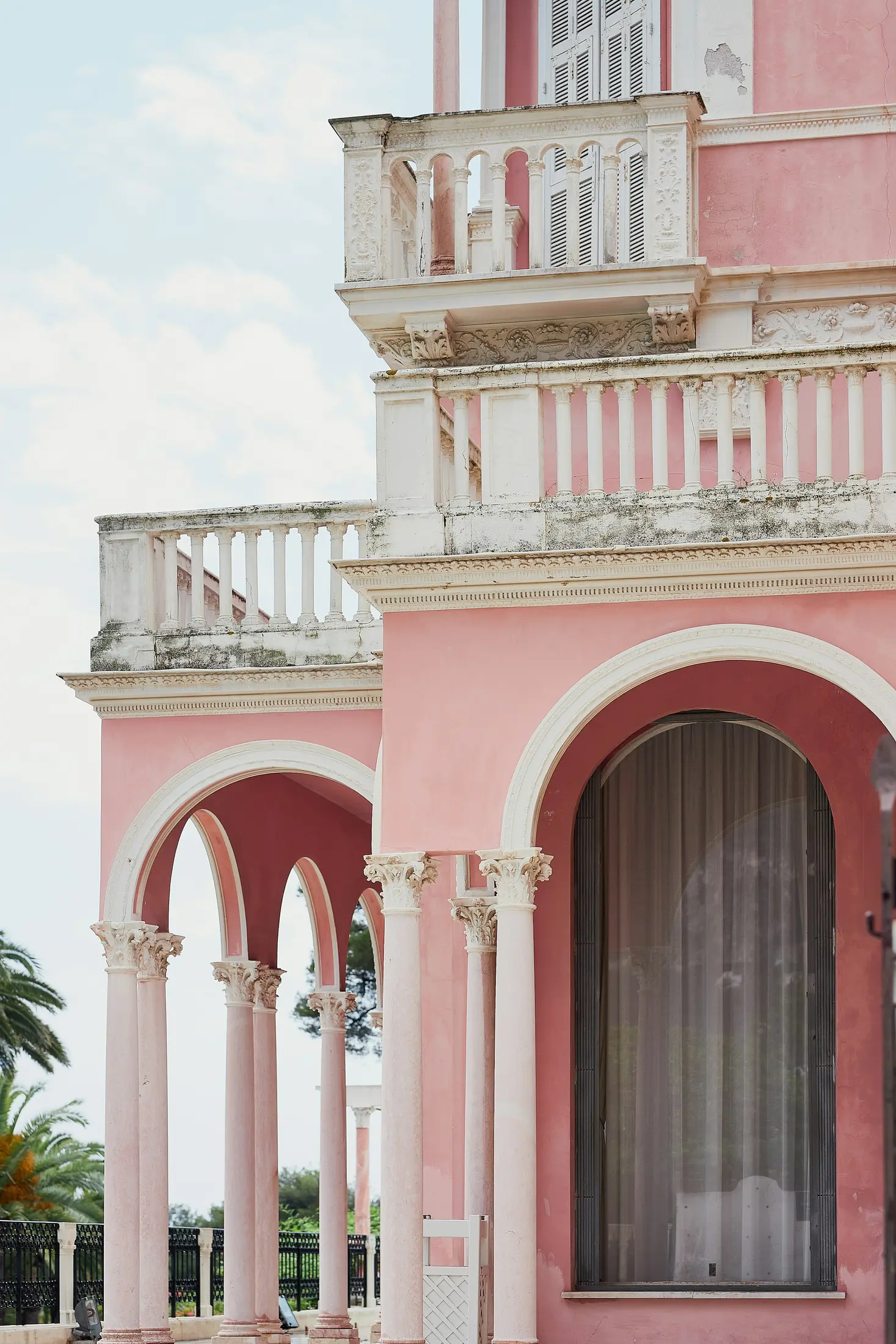
Begin outside, before treating the interiors as the main event. The villa’s architectural account distinguishes a varied northern entrance front from the more symmetrical southern front facing the formal garden. Italian Renaissance references sit alongside a Gothic entrance porch. This is an early twentieth-century composition drawing on older architecture, not a Renaissance house transplanted intact to France.
Look for the difference between a close view and a distant one. At an entrance, a carved detail, column or change of scale can hold the attention. From the garden, the rhythm of openings and the alignment of the facade become more legible. Moving between those viewpoints explains more than simply calling the building ornate.
The familiar pink exterior also belongs to a history of change. The villa’s chronology records an earlier ochre color and later restoration in pink tones. Avoid reading every surface as untouched evidence of Béatrice’s own day. A historic house can preserve a founder’s ambition while carrying the decisions of subsequent custodians.
Which collections deserve a slower look?
Rather than trying to absorb every object, choose a material. Porcelain provides a useful route into Béatrice’s taste and the craft behind a highly decorated interior. The villa’s collection notes distinguish Sèvres porcelain in the dining-room display from the predominantly Vincennes works in the adjoining porcelain room, connecting the two French manufactories through objects that reward close attention.
Compare shape, painted surface and scale before moving on. A vase designed to command a room asks to be seen differently from a small piece intended for close inspection. Read the labels for maker, date and provenance; the room’s atmosphere should not replace the individual object’s history.
The official guide to the state apartments offers another route, through furniture, tapestries and paintings. Choose a few objects that interest you and give them time. With guests, that approach leaves room for conversation instead of turning the visit into a march through names. Displays and loans can change, so avoid promising a particular work without checking its availability.
What do the gardens add to the story?
The formal French garden sets out a long view through water and planting toward the Temple of Love. The official garden history describes a ship-deck conception, connected with the villa’s original name, Île-de-France. The sea on both sides helps make that idea legible.
Smaller spaces change the pace. The Spanish garden gathers planting around a patio, while the stone garden places sculptural and architectural fragments in shade. These settings invite closer looking after the expansive formal view.
The gardens also have a restoration history. The villa’s chronology records later work by Louis Marchand and damage during the severe winter of 1985; its garden guide describes restoration of the Japanese garden in 2016. Maintenance is part of the story, not merely work happening behind it.
An October visit should emphasize structure and setting rather than expect the rose display that the official guide associates with May to July. Ask about temporarily closed paths. Return in another season to see how planting changes the same space.
How do you organize tickets, arrival and lunch?
Practical information was checked on October 15, 2026. The official access page publishes 10 a.m. to 6 p.m. through November 1, 2026, with last admission 30 minutes before closing. Exceptional closures and early closing notices can override that schedule. Recheck the villa’s own website for the actual day and use its linked ticket office; do not extend these hours into a later season by assumption.
For a private car or driver, plan the arrival as well as the journey. The official access page lists on-site parking subject to availability and asks taxi and private-hire drivers to follow security staff’s directions. Agree on a collection point and a flexible return time. The same page states that luggage storage is unavailable, so settle suitcases at the accommodation before visiting.
Restaurant Béatrice overlooks Villefranche Bay and is reserved for visitors to the villa. Its official page provides a separate reservation channel and a seasonal operating calendar. Book it deliberately if lunch is important to the day; a villa ticket does not establish a table reservation. Check restaurant hours independently of the museum’s hours, especially outside summer.
If someone in the party needs step-free access, contact visitor services about the intended rooms and garden route before booking. A general accessibility statement is less useful than confirming the surfaces, gradients and route that the person will actually use. Keeping the visit manageable is part of taking the place seriously.
Could this become part of your own Riviera life?
A home near Saint-Jean-Cap-Ferrat might make a morning among collections, lunch with visiting friends and an unhurried return part of an ordinary week. SDM Luxury Real Estate can help translate that aspiration into a location choice and property search, whether you imagine a seasonal base or a longer stay on the French Riviera. Begin with a private advisory conversation about the places and routines you want close at hand.
General information only, reviewed October 15, 2026. Opening times, displays, garden access, ticket conditions and restaurant arrangements can change; confirm the details directly with the institution before visiting. The photograph depicts Villa Ephrussi de Rothschild, a public cultural landmark, not an SDM listing. SDM does not claim a partnership with the villa or privileged access.
Primary sources
Official information and further reading
Facts and links reviewed October 15, 2026.
- Académie des beaux-arts — Béatrice Ephrussi de Rothschild (opens in a new tab)
- Académie des beaux-arts — villa, collections and bequest (opens in a new tab)
- Villa Ephrussi — historical chronology (opens in a new tab)
- Villa Ephrussi — exterior architecture (opens in a new tab)
- Villa Ephrussi — porcelain collection (opens in a new tab)
- Villa Ephrussi — gardens (opens in a new tab)
- Villa Ephrussi — opening times and access (opens in a new tab)
- Villa Ephrussi — Restaurant Béatrice (opens in a new tab)
Published by SDM Luxury Real Estate (opens in a new tab) / Nice, France
Last reviewed .