
What happened at Villa Nellcôte in 1971?
Villa Nellcôte was the rented home of Keith Richards in Villefranche-sur-Mer, on the French Riviera between Nice and Monaco. During the summer and autumn of 1971, its basement rooms became the principal French recording base for much of the Rolling Stones’ album Exile on Main St. A mobile studio remained outside, cables ran through the house, and musicians worked in separate rooms below it.
The careful version of the story matters. Exile was not created entirely at Nellcôte. Work on songs that would appear on the album had begun at Mick Jagger’s Stargroves estate and continued at Olympic Studios in London. The villa was nevertheless where the album acquired much of its character: a domestic address made to perform a task for which it had never been designed.
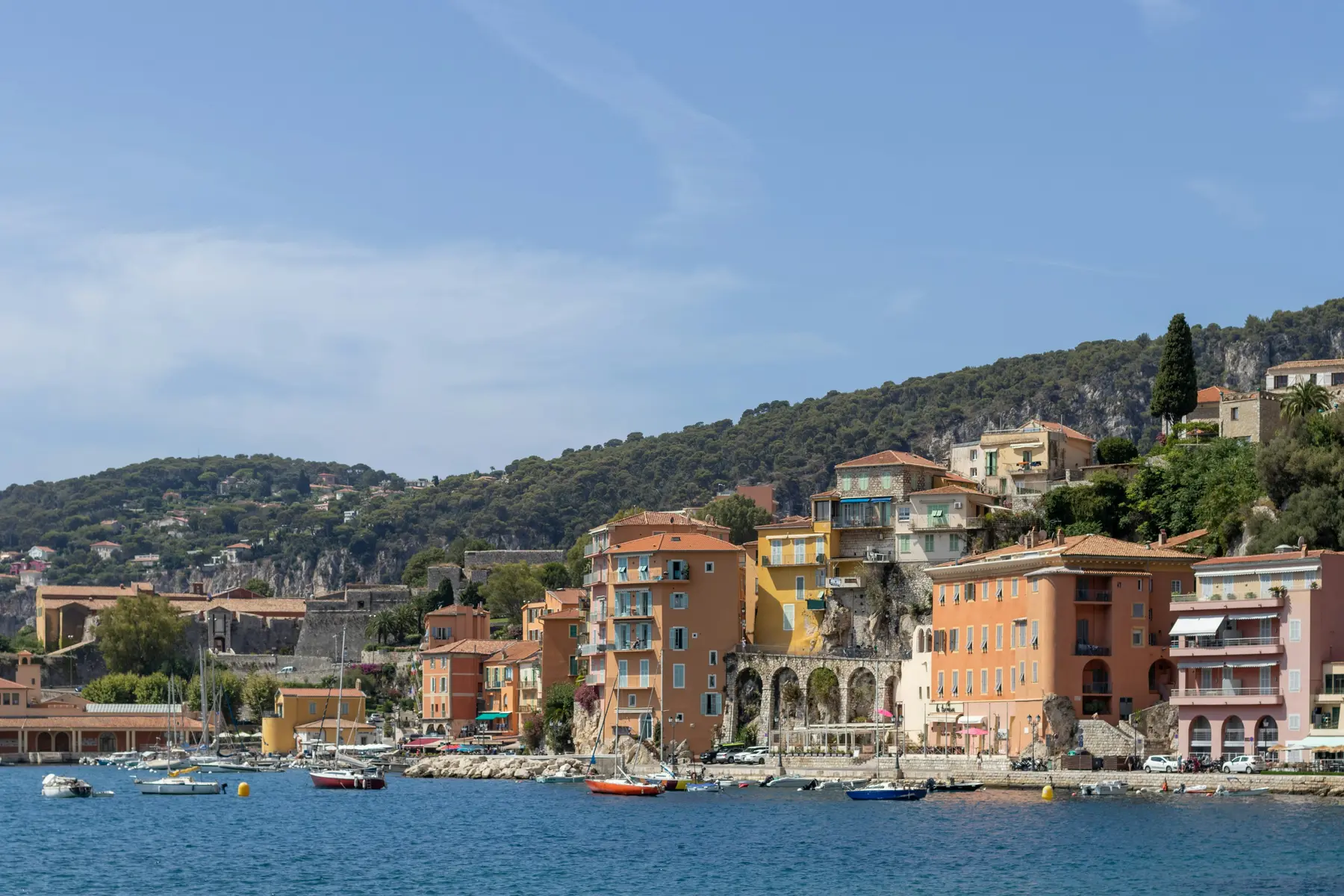
The sources for this account—including the 2010 documentary Stones in Exile, contemporary photographs and later recollections by the band—were reviewed on September 15, 2026. The photograph accompanying this article shows present-day Villefranche-sur-Mer as location context. It is not Villa Nellcôte or an archival image of the sessions.
Why did the Rolling Stones move to France?
The band left Britain in the spring of 1971 for tax reasons. The move was dispersed rather than communal. Bill Wyman and Mick Taylor established themselves around Grasse; Charlie Watts found a home farther west; Mick Jagger divided his time between Paris, the South of France and a property at Biot. Richards rented Villa Nellcôte in Villefranche-sur-Mer.
That geography is revealing. Villefranche lies immediately east of Nice, with a deep natural harbor and hills that rise sharply from the waterfront. The better-known Saint-Jean-Cap-Ferrat is across the bay, while Monaco is farther east along the coast. Nellcôte offered Richards a substantial home and privacy, but the band still needed a place to record while its members were living across southern France.
With no conventional studio serving the group’s needs, the Rolling Stones brought their own mobile recording unit to the villa. It was a practical decision with creative consequences. A home became workplace, gathering place and temporary production infrastructure at the same time.
How did a Belle Époque villa become a recording studio?
The mobile unit—the Rolling Stones Mobile Studio—was positioned outside and connected to the basement by cables. The musicians did not perform together in a single purpose-built room. The lower level was divided into smaller spaces, so instruments were placed in different areas and connected back to the control equipment.
Bill Wyman later remembered testing different rooms for sound. Richards described a basement in which a musician could hear the drums before finding the room where Charlie Watts was playing. Those recollections explain the working problem more clearly than the familiar photographs of the villa’s facade: the recording depended on adapting awkward spaces rather than enjoying a perfectly appointed studio.
Heat, humidity, electrical limitations and an irregular timetable made the process difficult. Yet those constraints also affected proximity and sound. The house separated performers physically while keeping the sessions inside a lived environment. To say that Nellcôte became an instrument is an interpretation, but a grounded one: its rooms shaped how the musicians heard and responded to one another.
Who was part of the Nellcôte sessions?
The core story belongs to the Rolling Stones, producer Jimmy Miller and the engineers who made the temporary arrangement function. It also includes musicians whose contributions were central to the album’s texture, among them saxophonist Bobby Keys and pianist Nicky Hopkins. The work did not follow the dependable schedule of a commercial studio, and not every member of the band was present for every session.
That irregularity is part of the record, but it should not be confused with the more lurid mythology that has accumulated around the house. The useful cultural history lies in the working conditions: people arriving, combinations of musicians forming, a rhythm being pursued after midnight, and technical staff translating performances from several rooms into recorded tracks.
Dominique Tarlé’s photographs remain an essential visual record of this period. They show work, family life and visitors sharing the same address. Rather than turning Nellcôte into a celebrity backdrop, the images help explain how thoroughly the boundaries between house and studio had dissolved.
Was all of Exile on Main St. recorded in Villefranche-sur-Mer?
No. The album has a longer geography. Some material predated the move to France, and further work continued after the Nellcôte period. The clearest description is that much of Exile on Main St. was recorded at the villa—not that the entire double album sprang from one summer or one basement.
That distinction does not diminish Villefranche’s importance. It makes the connection more credible. Nellcôte was one decisive chapter in a record assembled across places and years. When Exile on Main St. was released on May 12, 1972, listeners encountered a finished album rather than an architectural document, but the villa’s working conditions remained embedded in its history.
The Recording Academy inducted the album into the GRAMMY Hall of Fame in 2012. Its afterlife has also included Stones in Exile, Stephen Kijak’s 2010 documentary, which uses archive material and the band’s recollections to return the story to France.
What does the story reveal about the French Riviera?
Nellcôte belongs to a broader Riviera history in which private houses have done more than frame a view. They have allowed artists, writers, musicians and patrons to work and gather outside the institutions that normally define their professions. The Gerald and Sara Murphy circle at Cap d’Antibes in the 1920s is an earlier example; the Stones at Villefranche provide a louder, more improvised version half a century later.
The comparison should not be stretched too far. The people, work and circumstances were different. What connects them is the role of a home in creative life: enough privacy to withdraw, enough space to bring people together, and a location that changes the tempo of the day without guaranteeing an effortless result.
Villefranche-sur-Mer today is a lived town with an old harbor, the historic Darse and steep residential slopes above one of the Riviera’s most recognizable bays. For a visitor, that contemporary geography is more rewarding than attempting to treat a private address as a museum. The album can be heard anywhere; the bay helps explain why this particular chapter happened here.
Could a French Riviera home become part of your own creative life?
The lasting attraction of Nellcôte is not the possibility of repeating its history. It is the idea that a home can support serious work as well as family, friends and the Mediterranean seasons. If you are considering a place with that combination of privacy, character and room to gather, SDM Luxury Real Estate can help translate the aspiration into a thoughtful location choice and property search across Villefranche-sur-Mer and the wider French Riviera. The private advisory link below is a discreet place to begin.
General information only, reviewed September 15, 2026. This cultural feature distinguishes documented recording history from interpretation. The contemporary photograph illustrates Villefranche-sur-Mer and does not show Villa Nellcôte, an archival session or an SDM listing. SDM Luxury Real Estate does not imply an affiliation with the Rolling Stones, the named musicians, record companies, filmmakers or institutions.
Primary sources
Official information and further reading
Facts and links reviewed September 15, 2026.
- uDiscover Music: Exile on Main St. in the band’s own words (opens in a new tab)
- uDiscover Music: the Rolling Stones’ move to France in 1971 (opens in a new tab)
- Apple TV: Stones in Exile documentary record (opens in a new tab)
- The Guardian: the Nellcôte sessions and Dominique Tarlé’s photographs (opens in a new tab)
- The Recording Academy: GRAMMY Hall of Fame (opens in a new tab)
- Nice Côte d’Azur Tourist Office: Villefranche-sur-Mer (opens in a new tab)
Published by SDM Luxury Real Estate (opens in a new tab) / Nice, France
Last reviewed .