
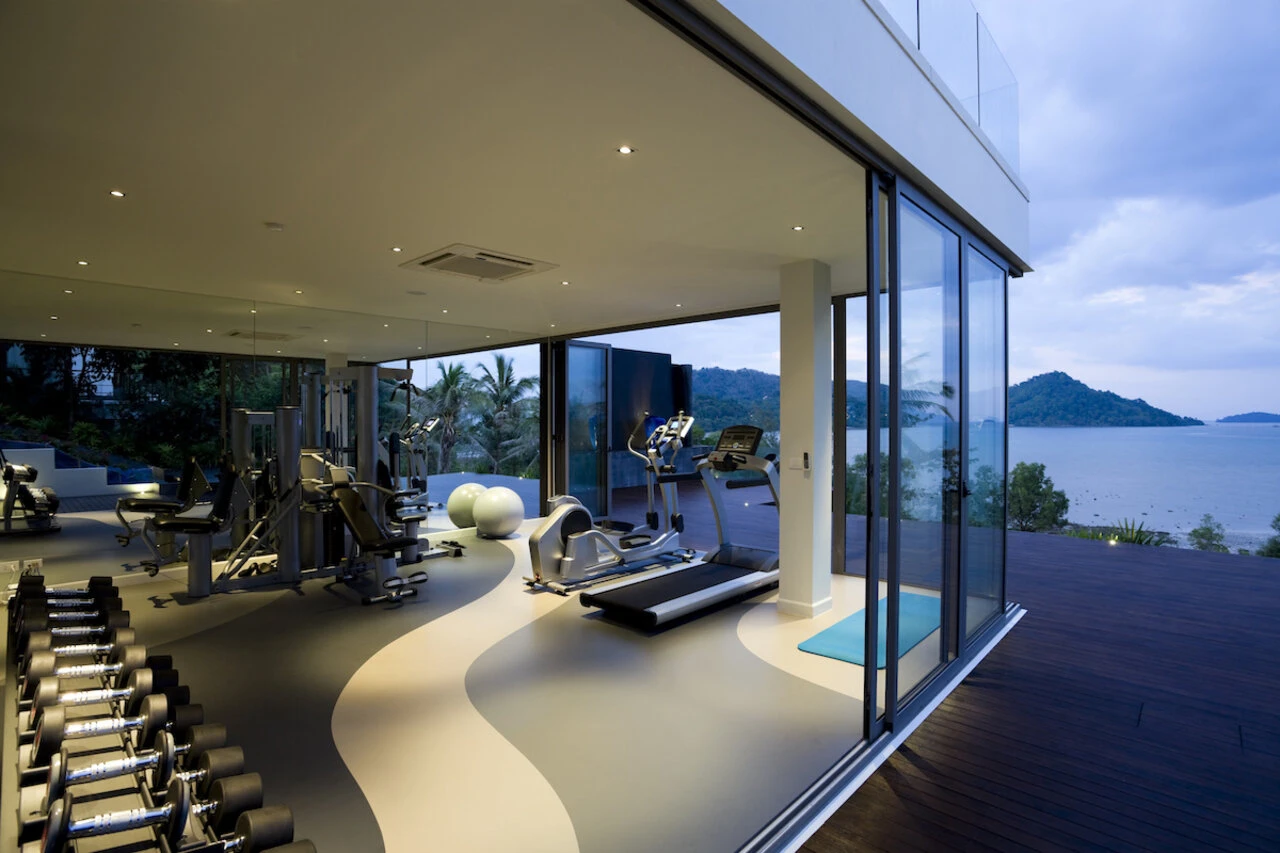
Residential gym with strength and cardio equipment and a water outlook. Archive reference image; not presented as a French Riviera property or an AEON-designed project. Photo: AEON Fitness image archive (opens in a new tab).
Should a home gym be part of your property brief?
A morning workout before the house wakes, an uninterrupted session with a trainer, or somewhere to maintain a familiar routine between trips: a home gym earns its place through use. On the French Riviera, the view can make that routine more inviting. It cannot tell you whether the room works.
If a property already has a gym, assess the space and its equipment separately. If it does not, establish whether a suitable room can be created before making that possibility central to the purchase. An attractive installation is not proof of technical suitability; an empty room is not automatically a renovation project.
This guide, reviewed October 27, 2026, treats fitness as part of choosing and enjoying a home on the Côte d’Azur, the French name for the Riviera. Start with the way you train, then test the property against it.
Do French Riviera homes normally come with a gym?
Do not treat a gym as an assumed inclusion. This review did not establish a representative measure of how many Riviera homes have one, so claims that it is standard across the market would go beyond the evidence.
Instead, distinguish what a particular property offers: a dedicated private room, equipment placed in a multipurpose space, or access to a shared facility. These are different propositions. Ask which equipment is included in the sale and have the agreed inventory recorded in the transaction documents.
The useful standard is a performance brief you set for the home: sufficient space for your routine, comfortable conditions, appropriate technical checks, manageable noise, and equipment that can be maintained. This is a buyer’s quality benchmark, not a universal legal specification or a promise of resale value.
What should you check in an existing gym?
Request model numbers, purchase and service records, operating manuals, and details of any leased equipment. Ask the supplier what warranty, software access and service support would remain available after a change of owner. A polished console reveals little about those arrangements.
With the seller’s permission and appropriate supervision, arrange a demonstration. Listen from adjoining rooms as well as inside the gym. Have the relevant professional investigate signs of damp, damaged flooring, loose fixings or installation problems. Ask what building work was carried out and obtain the associated records.
Then compare the room with your actual week. A row of cardio machines may leave too little space for strength work, mobility or a trainer. Equally, a simple, well-maintained installation may already do everything you need. Retaining useful equipment can be more sensible than replacing a room for its appearance alone.
How much space does a home gym need?
There is no useful single room size without a training brief. List who will use the gym, whether two people train together, and which activities need permanent equipment or clear floor space. Include storage, circulation and the space a trainer needs to work alongside someone.
Distinguish a machine’s footprint from its operating area. Concept2, for example, lists its RowErg at 244 × 61 cm (8 × 2 ft), but recommends 274 × 122 cm (9 × 4 ft) with clearance for use. That is a product-specific example, not a room standard or an equipment recommendation.
Draw the layout using the selected manufacturers’ requirements. Check ceiling clearance through the full movement, doors opening, access around benches and safe routes past moving equipment. A room that fits everything on a shopping list may still be too crowded to enjoy.
Which building checks matter before installation?
Ask a structural engineer to assess the proposed equipment, users, concentrated loads and intended activities where structural suitability needs establishing. Do not infer floor capacity from the building’s age, a stone finish or the fact that weights are already present. Floor protection and structural adequacy are separate questions.
Discuss impact noise and vibration with the project team, particularly beside bedrooms or above another residence. Specify the flooring system for the intended activities and existing construction. Ask what it can realistically achieve rather than assuming a rubber mat resolves every noise issue.
Have ventilation, cooling and any moisture problem assessed for the room’s use. Concept2’s home-gym guidance identifies air circulation and temperature control as comfort considerations and cautions against exposure to moisture and extreme temperatures. A sea-facing window or terrace is appealing, but equipment should only be installed in conditions its manufacturer permits.
Confirm power requirements with the supplier and electrician. Include the delivery route: gates, stairs, lifts, tight turns, assembly access and eventual removal. For a hillside house, getting a machine to the entrance is only the first part of delivery.
What if the house has no gym?
Compare possible rooms before choosing the most photogenic one. Consider privacy, daylight, glare, access from the main living spaces, nearby bathrooms and disturbance to guests. A smaller room used comfortably every morning may serve you better than a large, isolated space.
Be especially careful with a garage conversion. France’s Service Public guidance says converting an enclosed, covered garage of more than 5 m² (about 54 sq ft) into living space requires a prior works declaration, or déclaration préalable. Exterior changes can also trigger formalities, and local planning rules may require replacement parking. Ask the municipal planning service how your exact gym proposal is classified; placing equipment in a garage and converting it are not the same project.
In a co-owned building, known as a copropriété, review the building rules with the project team. Service Public requires prior co-owner approval for work affecting common parts or the building’s exterior. This can matter for structural intervention or an external air-conditioning installation. French rules here concern properties in France; Monaco has its own framework.
Our guide to buying a French Riviera property to renovate explains why feasibility should be tested before renovation assumptions determine an offer.
When is redesigning the gym worth considering?
Redesign has a clear purpose when it addresses a specific shortcoming: equipment you never use, poor circulation, uncomfortable conditions, insufficient storage or a layout that excludes another household member. Separate necessary technical work from optional finishes and equipment upgrades in the budget.
Start with what can stay. Repositioning suitable equipment, freeing a movement area or improving lighting may be enough. If you are considering a sauna, shower or cold plunge, commission a separate technical assessment of the additional services and building implications before folding it into the gym plan.
Judge the result by how it supports your life, not an assumed price premium. For a seasonal home, also agree who checks and services the equipment between visits. Our guide to managing a Riviera second home remotely covers the wider household arrangements.
Who should help shape the gym brief?
Fitness planning and building design answer different questions. A fitness consultant can translate your routine into equipment priorities and a functional layout; the appointed architect, engineers and contractors establish and deliver the building work within their professional responsibilities.
For one service reference, AEON Fitness’s Monaco home gym design and consulting page (opens in a new tab) describes training briefs, equipment selection and coordination with an owner’s project team. Its stated design scope is functional gym planning and equipment layout. Architectural, structural, electrical and construction work remains with appropriately qualified professionals. Confirm the location, site involvement and delivery responsibilities for any French Riviera engagement. Disclosure: AEON Fitness is a business associated with this publication’s owner.
A Riviera home should make room for the habits you want to keep, as well as the people you want to welcome. Whether that means refining an existing gym or finding a house with the right potential, SDM Luxury Real Estate (opens in a new tab) can help make those priorities part of a focused location and property search.
General information only. This website is not legal, tax, financial, immigration, or investment advice. Buyers should consult qualified French and cross-border advisors before making decisions. Gym planning also requires property-specific advice from the relevant building and technical professionals and compliance with the selected equipment’s instructions. Reviewed October 27, 2026.
Primary sources
Official information and further reading
Facts and links reviewed October 27, 2026.
- AEON Fitness: Monaco home gym consulting scope (opens in a new tab)
- Concept2: RowErg dimensions and operating clearance (opens in a new tab)
- Concept2: home gym planning and environmental conditions (opens in a new tab)
- Service Public: garage conversions and planning formalities (opens in a new tab)
- Service Public: works in a co-owned building (opens in a new tab)
- Life Fitness: equipment manuals and technical documentation (opens in a new tab)
Published by SDM Luxury Real Estate (opens in a new tab) / Nice, France
Last reviewed .